Originally published on 6/2 2026
ESGFIRE returns since 2018: + 1000 %
Don’t forget to subscribe to our newsletter since that is our main point of contact with our readers.
Click this link to sign up for our free newsletter!
Market outlook – January 2026
Resilient Markets with Shifting Leadership:
Global equities entered 2026 on firm footing, though the dynamics have evolved. Mega-cap tech stocks paused near all-time highs, while cyclicals and smaller caps picked up steam . Central banks are cautiously easing, and macro indicators signal a soft landing rather than recession. Key themes from December 2025 and January 2026 include:
-Large vs Small Caps:
After 2025’s AI-driven surge in large caps, small-cap equities are showing renewed strength. Lower interest rates and a solid economy have fueled a catch-up rally in the Russell 2000, which built momentum into year-end . Investors are broadening out beyond tech, seeking value in beaten-down smaller names.
-Rates & Liquidity:
The U.S. Federal Reserve paused its rate-cutting cycle in late January, holding the policy rate at 3.50–3.75% . This followed three consecutive 25 bp cuts in late 2025. The Fed’s tone turned slightly hawkish as growth remains “solid” and unemployment stable . However, Chair Powell signaled openness to further cuts later in 2026 if inflation continues to decline . With central banks in wait-and-see mode, liquidity conditions have improved from a year ago, easing pressure on credit markets.
-Inflation & Jobs:
Inflation ended 2025 near the Fed’s comfort zone – core CPI came in around 2.6% year-over-year – although core PCE is expected to tick up before settling ~2.5% by late 2026. Meanwhile, the U.S. labor market cooled but stayed healthy: unemployment held ~4.4% in December with only 50k jobs added , reflecting a significant hiring slowdown from 2024. Wage gains have moderated, helping inflation, but robust consumer spending (backed by rising real incomes) continues to underpin growth .
-Energy & Commodities:
Oil prices rebounded off late-2025 lows, approaching four-month highs by end-January. Brent crude hit ~$68 on Iran-related geopolitical tension and a weaker US dollar . OPEC+ supply tweaks have kept the market balanced; after a brief glut scare in October (when Brent dipped to $60 ), production discipline and outages helped lift prices. Industrial commodities are mixed – copper and metals paused after strong 2025 gains, awaiting clearer signals from China’s economy.
-Geopolitics & Policy:
Energy security and climate policy remain focal. In January, a U.S. carrier group’s presence in the Middle East and tentative Russia-Ukraine talks injected both risk and relief into markets . On climate, countries are digesting the late-2025 COP30 summit outcomes, which reaffirmed commitments to 1.5°C and could spur new clean energy investments (e.g. EU adaptation funds, U.S. incentives). Meanwhile, the newly inaugurated U.S. Congress is weighing an infrastructure-oriented spending package – a potential boon for “real economy” transition themes if passed.
Overall, investor sentiment is cautiously optimistic. Easing inflation and rate relief provide a supportive backdrop, but elevated valuations and lurking risks (policy uncertainty, geopolitics) suggest volatility will persist. Diversification and selectivity are key as the cycle matures .
Takeaways for investors – January 2026
-Focus on Fundamentals & Solutions:
After last year’s exuberance in certain thematics, it’s crucial to refocus on companies delivering real earnings and solving tangible problems. We favor businesses with strong fundamentals in “solutions” sectors – e.g. renewable energy, sustainable agriculture, electrification – where policy support and secular demand provide a tailwind. Avoid chasing hype; insist on revenue traction and proof of concept.
-Be Opportunistic in Volatile Markets:
With macro cross-currents likely to spur market volatility, keep some dry powder. January’s crosswinds (Fed pauses, geopolitical news) reminded us how quickly sentiment can shift. Use pullbacks to accumulate high-conviction positions at better valuations. We see volatility creating entry points in names tied to long-term themes like EV charging and circular economy – areas where short-term noise doesn’t derail the structural growth story.
-Financing & Cash Flow Matter:
The financing environment for growth companies is improving modestly – interest rates are off their peaks and investor appetite for green projects is returning. Still, capital is selective. Companies with strong balance sheets or access to non-dilutive funding will have an edge in 2026. Favor firms with manageable debt and clear paths to positive cash flow. Many climate-tech innovators raised capital in late 2025; we’ll be watching how efficiently they deploy it. Sound capital allocation and cost discipline are as important as top-line growth this year.
-Real-Economy Buildout is Accelerating:
From EV charging stations to renewable fuel plants, actual infrastructure is being built at an unprecedented pace. This translates to revenue for solution providers. We’re monitoring execution – e.g. project deliveries, factory ramp-ups – as a gauge of who will emerge as winners. Investors should track on-the-ground milestones (permits, project commissions, offtake deals) in addition to headlines. 2026 will separate the contenders from the pretenders in the energy transition, so we remain tilted to companies demonstrating real operational progress (not just glossy PowerPoints).
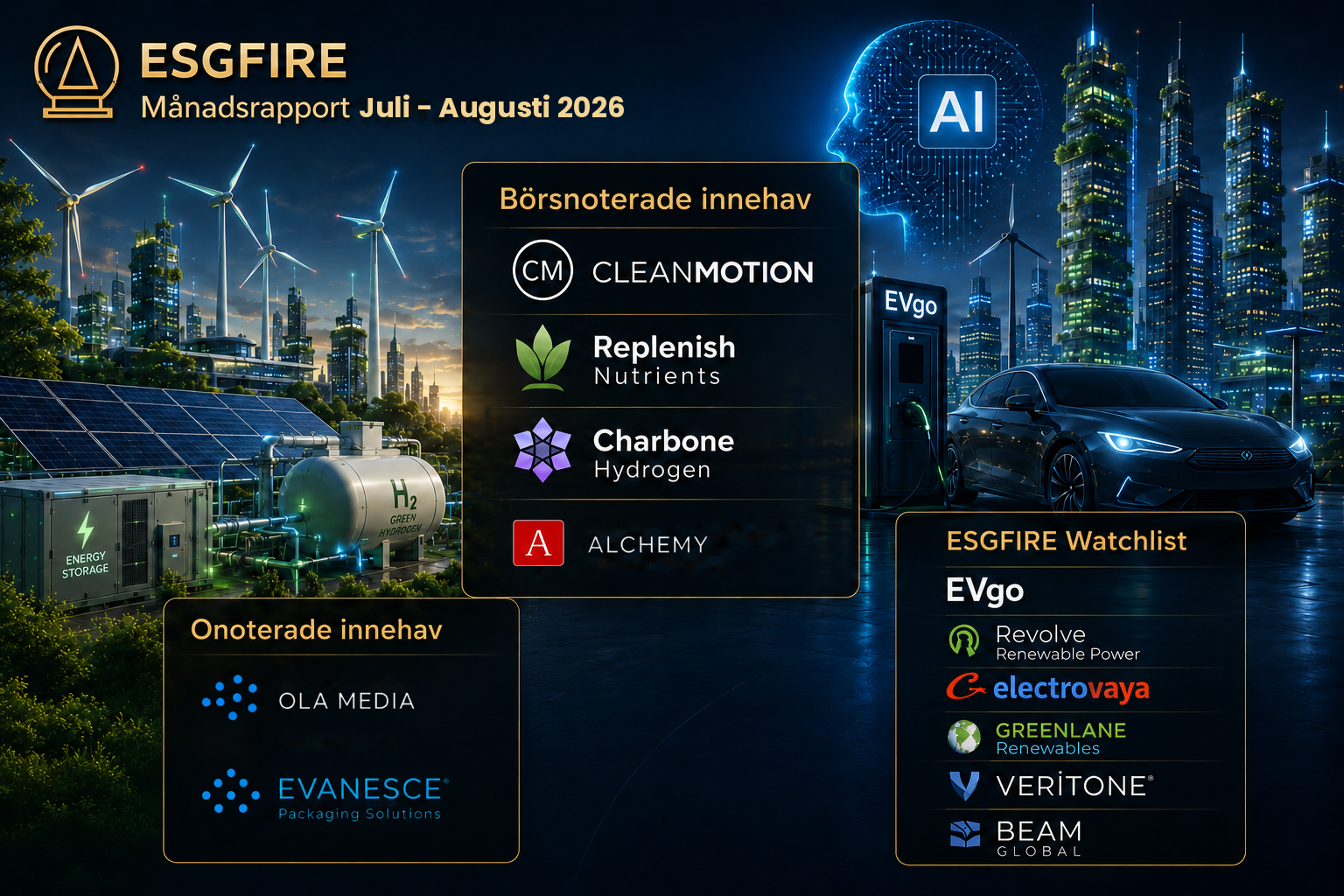
Current ESGFIRE portfolio – public holdings (January 2026 updates)
Clean Motion (Public EV Manufacturer First North: CLEMO)
Performance – November 2025:
-Approx. +20% (share price rose from ~SEK 0.10 to ~0.12 ). The stock bounced off all-time lows as investors reacted to a flurry of corporate news.
Key developments:
-First EVIG orders:
Clean Motion received its first commercial order for the EVIG “Memorial” solar electric hearse – Bestattung Wien (Vienna’s municipal funeral services) ordered 3 vehicles for Q1 delivery . This niche sale validates EVIG’s product-market fit in specialty urban transport.
-New website & branding:
The company launched a revamped corporate website to showcase its expanded EVIG product lineup and segment-specific solutions . This follows an updated go-to-market strategy announced on Jan 9, with four EVIG models (Delivery, Utility, Event, Memorial) tailored to distinct use cases .
-Product strategy update:
Clean Motion detailed its refined strategy focusing on high-use urban segments (parcel delivery, municipal services, mobile retail, etc.), introducing the four dedicated EVIG variants . Management emphasizes that concentrating on defined niches will drive customer adoption and long-term growth.
Replenish Nutrients (Regenerative fertilize CSE: ERTH)
Performance – January 2026: +25% :
hares rallied from ~C$0.11 to ~C$0.14 during the month , reflecting renewed investor optimism after significant year-end development
Key developments:
-Facility ramp-up:
Replenish confirmed that its new Beiseker granulation plant in Alberta is now largely commissioned and achieving production rates of 4–5 metric tonnes/hour . This validates the facility’s design capacity (~2,000 tonnes/month) and positions the company for record output in 2026.
-New product & market launch:
The company introduced a patented pelletized fertilizer product with simpler manufacturing and debuted “Replenish 1,” a retail lawn-and-garden granulated fertilizer, with initial distribution in Western Canada . These offerings expand Replenish’s addressable market and diversify its revenue streams (from large-scale ag into retail consumer).
-Major licensing deals:
In late 2025, Replenish signed two transformative licensing agreements – one with MJ Ag Solutions in Northern Alberta/B.C., and another with Farmers Union Enterprises in the U.S. Midwest – enabling partner-funded production facilities (10,000 and 50,000 tonnes/year initial capacities, respectively) that will manufacture Replenish’s fertilizer formulas . Under these deals, Replenish earns $40–$60 per tonne in royalties without heavy capex, a capital-light growth model validated by these first partners. Initial licensed production is expected to begin later in 2026.
-Balance sheet strengthened:
Replenish highlighted that it raised ~C$5.6 million in new debt/equity financing during 2025 and settled many legacy payables , significantly improving liquidity. This was evidenced by an oversubscribed private placement announced Jan 23 for up to C$3M (at C$0.12/unit) to fund growth . The improved balance sheet should support the ramp to positive cash flow as operations scale.
ESGFIRE view:
Replenish Nutrients enters 2026 with impressive operational momentum. After years of development, the company is graduating to commercial scale: the Beiseker plant is hitting throughput targets, and the innovative licensing strategy is bearing fruit with credible partners. We see these milestones as de-risking the story – the technology works at scale, demand for regenerative fertilizer is real (repeat orders, new products launched), and the capital-light expansion means growth won’t be bottlenecked by funding needs. Replenish’s focus now must turn to execution: achieving steady-state production, fulfilling orders, and collecting licensing revenues. We believe 2026 will be an inflection year where Replenish can prove its economic model (high-margin royalties plus direct sales). Given the strong policy support for climate-smart agriculture in Canada and the US (e.g. federal grants and corporate regenerative farming commitments ), Replenish is extremely well positioned. We remain bullish and would look to add on any weakness.
Charbone Hydrogen (Green Hydrogen Producer TSX venture: CH )
-Performance – January 2026: -35% :
Charbone’s stock declined from ~C$0.20 at year-end to ~C$0.13 by late January , giving back some of its late-2025 rally. Investors reacted to a needed financing and a broad market rotation out of small-cap cleantech, despite the company’s positive operational news.
-Charbone Hydrogen (TSXV: CH; OTCQB: CHHYF) is a Canadian producer of clean ultra-high-purity (UHP) hydrogen and integrated distributor of industrial gases. It is currently the only pure-play green-hydrogen producer on the Canadian public markets, making it a first-mover in a sector benefiting from generous tax credits and industrial-policy support.
Key January developments:
-First revenue shipments:
In late December, Charbone delivered its first commercial batches of green hydrogen from the Sorel-Tracy plant to paying customers – a milestone that officially moved the company from R&D into revenue generation. This initial delivery (to an industrial client) marks the start of Charbone’s product sales and validation of its modular electrolysis model.
-U.S. market breakthrough:
Charbone secured its first U.S. hydrogen supply order in mid-January, from a New York State customer affiliated with a major Japanese conglomerate . This order – for ultra-high purity (UHP) hydrogen – is strategically significant, opening the door to the U.S. tech corridor (“Tech Valley”) and demonstrating cross-border demand for Charbone’s green H₂ . Volume details are confidential, but management noted it will be fulfilled with existing capacity and is part of building long-term relationships in the U.S. market.
-Government sales in Canada:
Charbone also began supplying hydrogen to an Ontario pilot project using fuel cell generators on film production sets . The Ontario Treasury department purchase (via Best Markets GSA) indicates public sector interest in off-grid hydrogen solutions for clean power. It’s a high-visibility use-case (replacing diesel generators on movie sets) that showcases hydrogen’s real-world viability .
-Growth capital raised:
The company closed an oversubscribed C$3.1 million private placement in early January , bolstering its cash reserves to fund expansion. This financing (done at market price with strategic investors) extends Charbone’s runway and validates investor confidence but did contribute to stock dilution. Charbone also restructured ~C$2.8M of convertible debt in late 2025 to ease near-term obligations .
ESGFIRE view :
Charbone Hydrogen has finally turned the corner from concept to commercial execution. In the span of a month, it logged first revenues, entered the U.S. market, and secured fresh capital – all extremely positive for the long-term thesis. The stock’s pullback in January, in our view, is more about general small-cap market pressure and the necessary dilution from financing than any fundamental issue. Indeed, Charbone’s operational progress is ahead of schedule: few micro-cap hydrogen companies can claim live deliveries and blue-chip customers. We expect the focus now to be on scaling output and securing repeat orders. The demand signals are encouraging (the Fortune 500 and government clients piloting Charbone’s H₂ could expand deployments). Key for 2026 will be how efficiently Charbone can ramp its production (the Sorel-Tracy plant’s target ~400 kg/day capacity ) and improve its economics. We remain patient investors here – hydrogen is a longer-term play – but Charbone’s tangible wins increase our confidence. Any further weakness in the stock, despite improving fundamentals, would present an opportunity to accumulate for those who can tolerate volatility.
First Canadian Graphite (natural graphite miningTSX venture FCI) – NEW portfolio addition
-Performance – January 2026: +30%:
We initiated a position in mid-January around C$0.33, and the stock ended the month near C$0.43 . Shares jumped on high-volume after the company released very positive exploration and metallurgy results, establishing early momentum for this critical minerals junior. (Note: FCI is thinly traded; small absolute price moves equal large percentages.)
Key January developments:
-Airborne survey & land expansion:
On Jan 12, First Canadian Graphite began a high-resolution airborne EM and magnetic survey over its flagship Berkwood Graphite Project in Quebec . Five high-priority target zones are being scanned to detect conductive anomalies (graphite) beneath the surface . Simultaneously, FCI staked 125 new mineral claims (~6,770 hectares) around Berkwood, expanding the project’s land package by ~70% . The survey area was immediately increased to cover these new claims . Management’s aggressive claim expansion reflects strong confidence in the district’s graphite potential.
-Breakthrough metallurgy results:
In mid-January, FCI announced preliminary metallurgical testing on surface samples from a secondary target (“Zone 3”) yielded exceptional results. Graphitic carbon (Cg) grades in the eight grab samples ranged from ~6.4% up to an astounding 39.7% , with an average ~22.9% Cg – confirming the presence of very high-grade material. Moreover, over 85% of recovered graphite flakes were in the large or jumbo categories (>~80 mesh) , a very favorable flake size distribution that commands premium pricing. These tests, conducted by partner Volt Carbon using a proprietary dry separation process, achieved battery-grade purity without chemical reagents . The ability to produce >95% pure graphite via clean, low-cost methods is a major de-risking event for the project’s economics.
-Strategic financing:
On Jan 26, FCI announced a private placement to raise up to C$2.6 million (8.67M units at $0.30) . Given the stock was trading above that level, we expect strong interest. The funds will primarily support a Spring/Summer 2026 drilling campaign to follow up on the new geophysical targets and Zone 3 discovery. Notably, insiders and strategic investors are likely participants – the company’s tight share structure (~25M shares out) and growing buzz make this an attractive financing.
ESGFIRE view :
We added First Canadian Graphite to the ESGFIRE portfolio as our pick for critical battery minerals exposure. The January news simply validated and amplified our thesis. High-grade graphite, especially large-flake that can be processed into EV battery anodes, is in short supply outside China. FCI’s Berkwood project checks all the boxes: tier-1 jurisdiction (Quebec), established resource with upside, proven metallurgy yielding battery-grade product, and now clear evidence that multiple zones on the property carry similar high-grade graphite (not just the initial deposit). In short, the blue-sky potential is converting to tangible reality. We see a re-rating underway as the market comes to appreciate Berkwood’s scale – if even a couple of the newly identified zones are drilled out, the total tonnage could multiply from the current 3 Mt . Additionally, the ESG angle is strong: FCI’s partner demonstrated a clean processing flow (no acids, no tailings) and even built a working Li-ion battery cell from Berkwood graphite . This could draw strategic interest from battery makers looking for sustainable North American anode material . The stock, despite its recent jump, still sports a sub-$15M market cap – which we view as deeply undervalued given the comparisons (peers with similar-grade projects are substantially higher). Of course, early-stage mining carries risks (drilling results, permitting, etc.), and FCI will need more capital to reach feasibility. But with catalysts on the horizon (spring drilling, potential resource update, strategic partnerships), we’re very excited about this addition. We plan to monitor the upcoming exploration closely and would not be surprised to see further price strength as results emerge.
ESGFIRE watchlist – January 2026 performance snapshot
Our watchlist is a curated list of promising, undervalued companies that we follow closely. These names are not necessarily portfolio holdings, but we monitor them for potential entry.
EVgo (EV fast charging network NASDAQ: EVGO)
Business:
Operates one of the largest public fast-charging networks for EVs in the U.S. with a focus on urban and retail locations. January performance: -5%, drifting from around $3.20 to $3.05 per share (Nasdaq) by month-end amid market volatility.
Key January catalyst:
Adoption of Tesla’s NACS standard. EVgo announced an accelerated rollout of NACS connectors on its chargers, targeting 500+ NACS plugs live by end of 2026 . It already deployed ~100 in a late-2025 pilot and highlighted that over 80% of new EV models are expected to use NACS by 2030 . This proactive standardization move positions EVgo to capture drivers of Tesla and other NACS-adopting OEMs. However, the news had a mild market reaction (stock down 1.3% on the day) , as it also implies near-term capex to retrofit stations.
Execution vs. sentiment:
We view EVgo’s continued network expansion and tech-standard leadership positively – the company is aligning with industry trends (recent partnerships with General Motors, Pilot, etc. already foreshadowed NACS). In January, there were no major financial results; the slight share price decline likely reflects profit-taking after a late-2025 bounce and caution around ongoing cash burn. Investors seem to be waiting for clearer signs of the path to profitability. We note that EVgo’s revenue is growing and its unit economics are improving as utilization rises, but the stock will probably remain range-bound until the market sees a tangible move toward operating breakeven (possibly in late 2026). We continue to watch how EVgo manages its capital spending (it raised capital last year) and executes new site deployments – any slowdown in buildout or unexpected capital raise would be red flags, whereas successful scaling of its Autocharge+ and NACS integration could re-rate the stock.
Revolve Renewable Power (distributed renewables developer TSX-V: REVV)
Business:
Develops and sells small-scale renewable energy projects (solar, wind, battery) in North America; also operates some distributed generation assets for recurring revenue.
January performance:
-14%, from ~C$0.18 to C$0.155 . The stock slid to all-time lows on light volume, with no company-specific news.
Key January catalyst:
None. (No major announcements in Dec/Jan. The last update was the November Q1 FY2026 report showing stable recurring revenues and progress on the project pipeline.)
Execution vs. sentiment: Revolve is in a quiet period as it works on monetizing parts of its project portfolio. In early 2025 it sold a 3 MW CHP project for US$1.5M, providing a liquidity boost , and it’s pursuing new acquisitions (e.g. a 30 MW solar project in Canada ). However, the market is firmly in “show me” mode. The lack of fresh deals in the last two months, combined with general risk-off sentiment in micro-caps, hurt the share price. We still appreciate Revolve’s strategy of generating cash from project sales to reinvest in its growing portfolio (minimizing dilution). The watchlist status here reflects that we want to see execution pick up – e.g. closing the acquisition of that 30 MW solar asset and securing financing for construction – before considering an investment. Sentiment could improve if the company demonstrates a repeatable model of flipping projects at healthy margins. Until then, the stock may languish. We note Revolve’s valuation is now very low (<C$15M market cap), so any positive catalyst (new contract win, strategic investor, etc.) could spark a sharp rebound.
Electrovaya (lithium-ion batteries NASDAQ: ELVA)
Business:
Canadian manufacturer of advanced lithium-ion battery systems, with a focus on material handling (forklift) batteries and developing solid-state technology. January performance: +20% (Nasdaq: from ~$9 to ~$11; TSX: from ~$12 to ~$14 CAD ). The stock continued its strong uptrend from 2025, hitting multi-year highs around mid-month before a slight pullback.
Key January catalysts:
Insider confidence & capital raise completion. Co-founder and former CEO Dr. Sankar Das Gupta exercised warrants to acquire ~0.5 million shares on Jan 20 , sending a signal of confidence (and injecting additional cash to the company). Additionally, Electrovaya closed an oversubscribed US$28.1M equity offering (announced in late December) which strengthened its balance sheet for its planned gigafactory in New York . This offering’s completion in early January removed an overhang and expanded U.S. institutional ownership.
Execution vs. sentiment:
Few stocks encapsulate the market’s view of execution and sentiment like Electrovaya. On one hand, execution has been excellent – the company consistently announced large purchase orders in 2025 (e.g. $8.7M follow-on order from a Fortune 500 retailer for its forklift batteries) and ended the year with a record order backlog and the funding to expand production . It’s also commissioning a new cell manufacturing facility (the “gigafactory”) that could be a game-changer for margins long-term. On the other hand, sentiment is sky-high (the stock rose roughly 5x in 2025), which introduces volatility. In January, momentum carried shares higher, but we did see profit-taking around the $15 (CAD) level as some early investors likely trimmed positions. We remain watchful: any stumble in execution – say a delay in the New York plant or a quarter of slower revenue ramp – could trigger a sharp correction given the lofty expectations. Conversely, if Electrovaya continues to hit its milestones (on-time factory build, new customer wins in heavy vehicle and energy storage markets), the stock’s re-rating could have further to go. It’s on our watchlist because it straddles that line: a fundamentally solid company in the right segment (battery tech) but one that has run very far, very fast. We’d look for a better entry on a dip or confirmation of cash-flow-positive operations (guidance is aiming for late 2026 for that inflection).
Greenlane Renewables (biogas upgrading systems TSX: GRN)
Business:
Provider of turnkey biogas-to-RNG upgrading equipment, serving projects like dairy farm digesters and landfill gas plants globally. January performance: -5%, roughly from $0.23 to $0.22 (TSX) – essentially flat in an illiquid month.
Key January catalyst:
None major. (Greenlane’s last press release was Q3 results in Nov; no new contract announcements in Dec or Jan. There was industry news of a few small contracts in Europe, but nothing formally disclosed by the company in this period.)
Execution vs. sentiment:
Greenlane is in a transition period. Execution-wise, the company has faced headwinds – 2025 revenues were down as RNG project final investments were delayed industry-wide. It has been focusing on product improvements (it filed a patent for a new nitrogen rejection technology in late 2025 ) and service contracts to generate recurring revenue. The lack of new system sales announcements in recent months suggests a softer order book, which tempers our enthusiasm. Sentiment around the stock is accordingly subdued – it trades near multi-year lows at ~0.6x book value. Investors appear to be waiting for evidence that the next wave of RNG projects (spurred by IRA incentives and higher carbon credit prices) will translate into Greenlane contract wins. We continue to watch Greenlane because it’s one of the few pure-plays in RNG equipment and could benefit from any uptick in project financing in 2026. However, we need to see a clear inflection in order flow or margins to turn constructive. Until then, the stock likely remains range-bound. One possible near-term catalyst could be the company securing a large landfill gas upgrading project (management hinted at late-stage bids in its last MD&A). Absent that, patience is required.
Veritone (AI software platform)
Business:
AI software and services company; its platform (aiWARE) is used in media, entertainment, advertising and government for tasks like content analysis and synthetic voice. January performance: -25%, with the stock dropping from ~$4.80 to ~$3.60 (Nasdaq) . This follows a massive run-up in 2025 (Veritone was one of last year’s best AI plays), and the pullback came despite continued positive news flow.
Key January catalysts:
Product expansion & debt reduction. On Jan 14, Veritone announced a major expansion of its Veritone Data Refinery (VDR) – adding a roster of new data suppliers to its platform, which helps companies monetize their proprietary datasets . This is aimed at capitalizing on the surge in demand for AI training data (Veritone processed a staggering 22.2 trillion data tokens in 2025) . Separately, the company disclosed it fully retired its senior secured debt facility, dramatically reducing annual interest costs by over 90% . This debt payoff, using proceeds from a late-2025 equity raise, cleans up Veritone’s balance sheet and frees cash flow for growth initiatives.
Execution vs. sentiment:
We see Veritone’s execution as strong – it has successfully repositioned itself as a picks-and-shovels player in the AI boom (providing data and model services to enterprises), and the debt elimination removes a key risk. However, sentiment had arguably overshot in late 2025, pushing the stock to valuations that priced in years of growth. The January sell-off likely reflects investors taking profits and recalibrating expectations (“sell the news” on good announcements). For us, Veritone remains a watch candidate; it’s one of the few small-cap AI names with real revenues (FY2025 ~$150M) and a path to profitability (non-GAAP profitability expected in 2026). We’re watching how new bookings trend in its advertising and government segments amid the broader AI frenzy. If the stock stabilizes in the $3 range and the company continues to execute (e.g. lands a big federal AI contract or accelerates Data Refinery adoption), it could become attractive again. Right now, volatility is high and the AI narrative is double-edged – it can spur rapid stock gains but also brutal corrections like we saw this month. Caution is warranted until the hype-churn subsides and core metrics (like ARR growth) take the driver’s seat.
Beam Global (off-grid solar EV charging NASDAQ: BEEM)
Business:
Manufactures solar-powered EV charging stations and portable energy infrastructure (EV ARC and Solar Tree products) for government, commercial, and consumer use. January performance: +5%, from ~$1.50 to $1.58 (Nasdaq), with the stock bouncing off December’s lows.
Key January catalysts:
Government & residential sales momentum. Beam announced on Jan 8 that the New Jersey state government (Department of Treasury) purchased multiple EV ARC charging units via the GSA contract . These off-grid units will be deployed for workplace charging at state facilities, highlighting Beam’s value in resilient, quickly deployable infrastructure. Later in the month, Beam secured its largest residential development order to date – a New York property developer bought 10 EV ARC systems for a new condo project’s EV charging needs . This sale into the private sector (a sign of growing interest from real estate developers) is noteworthy as most of Beam’s past sales were to government or fleets.
Execution vs. sentiment:
Beam Global’s execution is gradually improving – its sales pipeline is converting, especially with government customers leveraging federal funds for sustainable infrastructure. The NJ order and others like it (e.g. the State of California and military bases are also Beam clients) validate the product-market fit. That said, sentiment around Beam remains cautious. The company is still operating at a net loss and had to raise capital in late 2025 to fund growth. The stock’s slight uptick in January indicates some bottom-fishing after a ~60% decline in 2025, but many investors want to see evidence of scale (e.g. quarterly revenues accelerating beyond the ~$5M level and approaching breakeven). We’re watching Beam on the watchlist because it stands to benefit from the broad push for resilient EV infrastructure – it offers a unique solution that doesn’t require construction or grid upgrades. If it can string together a few more quarters of 50%+ growth (and manage costs), market sentiment could turn significantly. Until then, we expect range-bound trading. The recent orders are a step in the right direction: it’s clear Beam’s backlog is building, but the timeline to profitability (likely 2027) keeps us in observation mode rather than ownership.
Non-public investment portfolio – January 2026 updates
ESGFIRE holds positions in the following private companies. We summarize any recent developments; if none, we note the latest known information.
Ola Media
Status in January:
Operating status unchanged; Ola continues to grow its digital media platform focused on sustainable lifestyle content. Latest public datapoints: The last disclosed user metrics (September 2025) showed ~1.2 million monthly active users and initial revenues from brand partnerships (no update since). No material news in Dec 2025/Jan 2026 – the company remains private and heads-down on product development.
ESGFIRE view: We remain invested awaiting a possible 2026 Series A funding round. Ola Media’s engagement metrics are steadily climbing, but we are eager for updated financials or a hint at monetization scaling. With no recent public info, our view is unchanged: it’s a high-potential impact media play, but we need to see evidence of revenue traction before increasing our stake. We anticipate an update from management by Q3 2026 .
Alchemy
Status in January:
R&D progressing; no change in corporate status. Latest public datapoints: Alchemy (still in stealth mode) last announced in Oct 2025 that it achieved a prototype of its novel long-duration battery with >500 cycles in testing. The company has not issued any public releases in Dec or Jan. Internally, we understand they are preparing for UL certification trials – but this is unconfirmed publicly.
ESGFIRE view: Unchanged (latest known info remains October 2025). We continue to believe Alchemy’s technology – if validated – could be a game-changer in grid storage (promising safer chemistry and 30% lower cost than lithium for multi-hour storage). However, the lack of near-term milestones or transparency keeps this in the higher-risk category. We’re content to hold our small position given the potential TAM, but we are eagerly awaiting a mid-2026 update which could include performance data or strategic partnership news. Until then, we recognize this investment requires patience.
Evanesce Packaging Solutions
Status in January:
Ramping manufacturing; the company is executing its expansion plan announced in 2025. Latest public datapoints: No new press releases in Dec 2025/Jan 2026. The most recent news (August 2025) was the opening of Evanesce’s first large-scale plant in South Carolina (capable of 1 billion units/year of compostable straws and containers) and the hiring of a VP of Global Sales . Those remain the latest public milestones.
ESGFIRE view:
Unchanged (latest disclosed info remains August 2025). We are optimistic about Evanesce as a leader in sustainable packaging – demand for compostable alternatives is only growing, and Evanesce’s proprietary starch-based technology gives it a cost advantage . Our checks with industry contacts suggest the new SC facility is operational and fulfilling initial orders to food service clients, which is encouraging. However, without fresh public data, we maintain a steady view. We’ll look for an official update on production volumes or new big-name customers (perhaps in a spring 2026 press release). If those materialize, it could significantly boost the company’s profile ahead of a potential IPO in late 2026.
About us:
ESGFIRE is a Swedish investment company and research firm that focuses on companies with either an environmentally friendly service or product. ESGFIRE has a performance record of over 1000 % returns since 2018. By only investing in environmentally friendly companies, ESGFIRE have outperformed the major indexes for several years. We have a track record of over 1100 % returns since 2018 using our own proven method of identifying high potential ESG companies.
Contact details
Website: www.esgfire.com
CEO: Filip Erhardt
Email: Filip@esgfire.com
Telephone:+46701609605
Legal Disclaimer
The stock price development above was calculated by taking the opening price at the first day of the month and the closing price at the last day of the month.
This post is based upon reliable sources, namely regulated press releases from the company, as referred to above. Nevertheless, this post may contain interpretations, estimates, or opinions of the authors, or other non-factual information. If that is the case, this is continuously stated above. Furthermore, any projections, forecasts, or similar are explicitly stated as such. These projections, forecasts, or similar have been conducted based on EV/SALES multiple calculations.
The author holds shares and/or other securities of these companies and the relevant
companies may or may not have paid the author for content posted on this website. This
may impact the content on the website. Because of the above, ESG Fire urges the visitors to always analyze all the posts critically in an objective manner, e.g., concerning the reliability of the relevant source and of what constitutes the authors’ personal interpretations. The visitor is hereby reminded that the post does, as set forth in the Post, contain interpretations, estimates, or opinions of the authors. This post was written by Filip Erhardt , at ESGFIRE , published at February 6th, 2026.
Investing in stocks is combined with certain risks and it is possible to lose your entire investment. Our posts are made for Educational purposes only and are not to be interpreted as tips , financial advice or recommendations of any kind to either buy or sell any stocks.
Companies may or may not be paying us for content posted on this website