Originally published on November 9th
ESGFIRE returns since 2018: + 1000 %
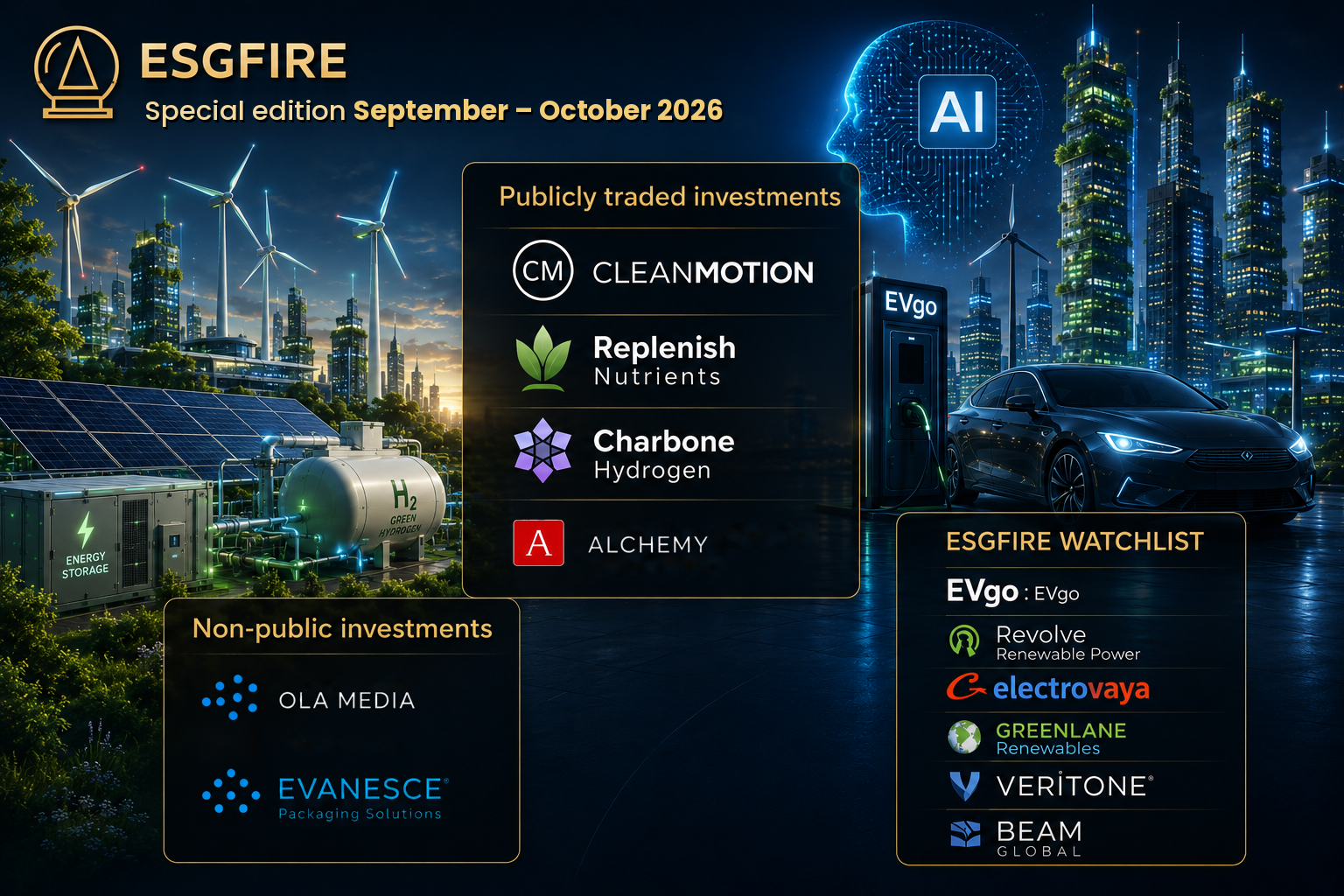
This is a special double issue. No September report was released, so this edition covers both September 2026 and October 2026 in one report, with each month kept visibly separate inside every company block. Two things define the autumn for our universe. First, the Canadian junior market that rallied 13 % in August gave almost all of it back and more – the S&P/TSX Venture Composite fell roughly 10 % in September and a further ~9 % in October – while the Federal Reserve delivered its first rate hike since 2023.
Second, our watchlist produced its first take-out: Revolve Renewable Power agreed to be acquired by Whitfield Power Solutions at C$0.23 per share in cash, a 31 % premium.
Click this link to sign up for our free newsletter!
How to read this report
The report follows the same framework as our monthly editions:
-Market – the macro backdrop and what drove capital flows in July and August;
-Takeaways– how we think investors should position after the summer;
ESGFIRE public portfolio – updates on our listed holdings, with a “Portfolio changes this summer” box;
ESGFIRE watchlist – companies we monitor for potential entry;
The Non-public investment portfolio*– our private investments.
Market outlook –September and October 2026
September
September was a month in which a flat headline index concealed a broad sell-off. The S&P 500 slipped about 0.3–0.4 % while the Nasdaq Composite gained roughly 1.9 % and set a new all-time high, as the AI trade resumed. Underneath, ten of eleven S&P sectors fell; the equal-weight S&P 500 lost 4.8 % and trailed the cap-weighted index by about 4.6 percentage points – one of the widest monthly gaps since 2003 – and the Russell 2000 dropped 5.3 %, its steepest monthly decline in more than a year. Growth beat value by roughly five points.
The macro backdrop tightened. On 16 September the Federal Reserve raised the funds rate by 25 bp to 3.75–4.00 % – the first hike since 2023 and a unanimous 12–0 vote – after a hot August CPI (3.4 %), with the median dot pointing to one more hike in 2026. Chair Warsh called it “removing accommodation” rather than tightening. Bond yields rose to multi-decade highs across developed markets, the dollar strengthened, and oil surged: Brent spot rose about 29 % over the month to ~US$116 after drones hit Saudi Arabia’s East-West pipeline (the main bypass around Hormuz) on 10 September; spot Brent peaked near US$131 on 15 September. Gold fell about 2 % as real yields rose. For our universe the key number was Canada: the S&P/TSX Venture Composite fell roughly 10 % (from ~983 to ~882), even as TSXV financings actually rose 69 % month on month to C$1.0 billion across 88 deals – almost all of it resource money.
October
October reversed the leadership again – and this time breadth won. The S&P 500 set a record close of 7,819 on 6 October and then fell 0.9 % for the month to 7,580 (closing 30 October one cent above its 29 May close – five months of going nowhere), with the Nasdaq-100 down almost 7 % as the market questioned AI cash burn: Meta reported its first cash outflow in over a decade on 22 October and Intel fell 29 % on weak guidance on 30 October. Yet more than 70 % of S&P constituents rose; the equal-weight S&P 500 gained about 5 %, its biggest outperformance against the cap-weighted index since April 2009; value beat growth by roughly ten points, the widest spread since 2000; energy (+14 %), staples (+11.6 %) and utilities (+10 %) led; and the Russell 2000 edged up 0.5 % to 2,812.
Rates paused. The September jobs report (2 October) showed only +29k payrolls with unemployment up to 4.2 %, and September CPI (14–15 October) stayed sticky around 3.6 %; the Fed held at 3.75–4.00 % on 28 October, with Warsh noting financial conditions had already tightened since the hike. Oil stayed elevated and volatile – Brent futures ranged roughly US$101–118 through the month, ending near US$117 after Houthi strikes on Saudi infrastructure – and the 10-year Treasury ended the month just under 5 %. Canada diverged badly: the S&P/TSX Composite fell about 1.7 % on the final day alone, and the S&P/TSX Venture Composite dropped a further ~9 % to ~804, with TSXV trading volume, value and transactions all down in October against both prior comparison periods.
What is driving capital flows – Autumn 2026 in five points
-Large caps vs. small caps:
September was mega-cap AI versus everything else (Nasdaq up, equal-weight −4.8 %, Russell 2000 −5.3 %); October was the mirror image (Nasdaq-100 −7 %, equal-weight +5 %, Russell 2000 +0.5 %). U.S. small caps therefore ended the two months down roughly 5 % net. Canadian juniors had no such relief: the TSXV fell both months, roughly −10 % and −9 %, surrendering August’s entire rally and more. For most of our public holdings this is the home market, and it was the single biggest drag on prices.
– Rates and liquidity:
The first Fed hike since 2023 (16 September) and a 10-year near 5 % raised the cost of capital for everyone without cash flow. October’s pause was a pause, not a pivot. TSXV equity financings rose sharply in September (C$1.0 billion, +69 % m/m) but that money went overwhelmingly to resource names; for clean-tech and technology small caps, the primary window stayed narrow and discounted – which is exactly what the autumn’s financings in our universe looked like (Veritone at US$0.75, First Canadian Graphite at C$0.45).
– Inflation and jobs:
Headline U.S. inflation re-accelerated (3.4 % in August, ~3.6 % in September) on energy, while payroll growth slowed to a crawl (+29k in September, 4.2 % unemployment). Sticky inflation plus a softening labour market is the combination that keeps central banks on hold at restrictive levels and keeps small-cap multiples compressed.
– Energy and commodities:
Oil was the macro story of the autumn: Brent spot +29 % in September to US$116, peaking near US$131, and holding roughly US$101–118 through October on the Hormuz deadlock, pipeline attacks and Houthi strikes. Helium stayed structurally short – a direct tailwind for Charbone’s distribution business. Gold fell about 2 % in September on higher real yields. Lithium weakened on oversupply. Energy was the best-performing S&P sector in October.
– Geopolitics and policy:
The Iran conflict and Gulf shipping disruption dominated. Western governments kept prioritising domestic supply chains, defence resilience and energy security – the policy backdrop for Alchemy’s Crypsis defence platform, for Charbone’s “Canadian industrial gas group” positioning, and for the U.S. drone-onshoring theme that Beam Global chased in October.
Sustainability and policy angle
The autumn confirmed what we wrote in May and again in September: the transition is being financed as industrial competitiveness, energy security and defence resilience rather than as climate policy. The market paid for energy, utilities, materials and “picks and shovels” in October and punished capital-hungry technology; clean-tech labels on their own earned nothing. Where our companies made progress it was physical – a cylinder-filling unit, a pellet line’s first sales, an electrolyzer being installed, a battery supply agreement for Class 8 trucks – and where they needed money, they paid for it.
Canadian small-cap / TSXV sentiment
Two months, two declines: roughly −10 % in September and −9 % in October, with October volumes falling. September’s financing surge (C$1.0 billion) was a gold-and-resources phenomenon that did not reach our names. For technology and clean-tech juniors on the TSXV the autumn was the hardest stretch of the year, and it is the main reason we read October’s share-price weakness across the portfolio as a market event first and a company event second.
Takeaways for investors – summer 2026
1. Separate the index from the stock
The TSXV fell ~18 % across September–October. When a company delivers (Charbone’s third straight quarter of gas-income growth, Electrovaya’s US$26 million Janus orders) and the share price falls anyway, the market is pricing the exchange, not the business. That is the setup we look for – and it is why we are patient rather than panicked.
2. Financing visibility is still the primary screen – and cost of capital is up.
A Fed hike and a 5 % ten-year made autumn financings expensive: Veritone raised equity at US$0.75 to meet a November note maturity, First Canadian Graphite raised C$5 million at C$0.45–0.58. Companies that financed in the summer (Alchemy’s IPO, Replenish’s C$15 million from SRC, Revolve’s Callaway facility) spent the autumn executing instead of selling shares. Hold the ones that do not need the market.
3. M&A is now part of the smallcap returns.
Revolve’s C$0.23 cash offer (a 31 % premium) is the first take-out on our watchlist, and Beam Global’s attempt to buy ScoutDI shows how acquisitive even cash-light small caps have become. When a market refuses to price execution, strategic and financial buyers eventually will. Watch for more of it in our universe.
4. Back the real economy buildout , not the narrative – and watch Q3 prints.
Phase 1B at Sorel-Tracy, 24-hour shifts at Beiseker, Jamestown equipment acceptance, cylinder filling brought in-house: the autumn’s portfolio news was physical. Q3 results across the portfolio land in November (Charbone 26 Nov, Replenish end-November. We judge the autumn on commissioning and margins, not announcements.
Current ESGFIRE portfolio – public holdings (July & August 2026)
Portfolio changes this summer
No transactions during September or October.
A note on First Canadian Graphite (TSXV: FCI): We exited temporarily in the summer at the time the company’s catalysts looked further out. In October FCI announced a C$3 million hard-dollar unit financing at C$0.45 (21 October) and a C$2 million flow-through financing at C$0.58 (23 October) to fund stripping and an anticipated 20,000-metre diamond drilling programme at Lac Guéret South, with claims and optioned ground now exceeding 200 km². That is a higher price than when we sold, and we say so plainly. The asset view is unchanged and the company stays on our radar; we may return once drill results are in hand.
Alchemy Labs (Nanotechnology – Crypsis defence tech and ExoShield windshield protection
IPO price C$1.00
Key September developments:
23 September: ExoShield ULTRA Pro vehicle-specific kit portfolio expanded to 40+ supported vehicle models across 17 kits (from more than 20 announced in August), adding major GM pickup and SUV platforms – a doubling of coverage within a single quarter, in line with the company’s year-end objectives.
Key October developments:
No company press release in October – the company’s news wire runs from 23 September straight to 2 November. The month’s only new material was ESGFIRE’s own CEO interview with Khanjan Desai, “Hiding Soldiers, Saving Windshields: Alchemy Labs CEO on the Road to Profitability” (published 7 October, Swedish version 4 October), covering the Crypsis defence pipeline, ExoShield’s channel build-out and the path to profitability.
Post-period (early November) – included because it changes the picture:
2 November: consortium agreement with Navim Group, an Italian marine engineering supplier to naval and commercial vessels, to develop and integrate Crypsis into sprayable naval and maritime coating systems for hard surfaces, with Surface Science Western (Western University, London, Ontario) providing materials characterisation and testing. The project falls under Canada’s Industrial and Technological Benefits (ITB) policy, tied to Navim’s work for Seaspan Shipyards under the National Shipbuilding Strategy. Project value ~€414,000, funded 50/50 by Navim and Alchemy; Alchemy retains all IP it generates. No timeline disclosed. This is the first application of Crypsis beyond textiles.
4 November: two-year supply agreement with an existing (unnamed) U.S. automotive-glass partner, granting it exclusive ExoShield distribution rights in the dealership channel across Texas. The programme launches this month at two GMC and Toyota dealerships (two more expected in the coming months), with participating dealers committing to ExoShield GT3+ installations plus a Glass Protection Warranty on new vehicles sold. Volume-based purchasing programme; no minimum volumes, dollar value or unit commitments were disclosed.
Share price: the stock traded down to within a few cents of its post-IPO low in the first week of October before stabilising – against a TSXV that fell ~9 % in the month.
ESGFIRE view (updated):
We are shareholders and Alchemy remains our largest position – our opinion and risk appetite, not advice. The two months under review were quiet on the wire and loud on the tape: kit coverage doubled, but the market wanted a second Crypsis customer and got a Canadian junior-market sell-off instead, taking the share to within cents of its post-IPO low.
Then the first week of November delivered exactly the two things we had been waiting for. The Navim consortium is small in money – roughly €207,000 of Alchemy’s own capital over an undisclosed period – but large in meaning: it moves Crypsis from textiles into coatings, from one customer (the Department of National Defence) to a second defence supply chain, and does so inside Canada’s shipbuilding ITB framework, which is where long-dated naval procurement money sits. The Texas dealership agreement is the first multi-year ExoShield contract and the first with channel exclusivity; it is also the first where we cannot see the size, since no volumes or values were disclosed, so we treat it as a channel proof point rather than a revenue line until Q3/Q4 numbers show it.
Nothing about the thesis changed in September–October – a near-39 % gross-margin business with a paying defence customer, trading 20 % below its IPO price – and November started to confirm it. The remaining proof points are the Q3 results, conversion of the DND textile programme from NRE into commercial supply, and the first dealership volumes. The share can stay under C$1.00 while those land; we hold because the evidence is now being built faster than it is being priced, and for the first time since the IPO the news flow is catching up with the tape.
Clean Motion (Public EV Manufacturer First North: CLEMO)
Key September developments:
No company press releases were identified in September.
Key October developments:
No company press releases were identified in October. The Q3 2026 interim report is scheduled for 13 November 2026. Pending items from the summer remain: the EIC Accelerator decision (first stage passed 14 July; decision expected around Q4), the TO4 warrants (exercisable January 2027, up to ~SEK 16.7 million), and delivery against the Averroes Gulf order (~SEK 8 million) and the Stockholm showroom/Action Talks launch announced for the fall.
ESGFIRE view (updated):
Filip Erhardt of ESGFIRE sits on Clean Motion’s board – read this as an insider’s view hence EGSFIRE is refrained from making comments about the company.
Replenish Nutrients (Regenerative fertilize CSE: ERTH)
Key September developments:
No formal press release in September. Management (CEO Neil Wiens, new Chairman Tim Close of SRC) gave investor interviews in late August/early September framing the SRC partnership as an operational “inflection point” and reiterating the Q4 target for full-scale granulated and pellet production.
Key October developments:
27 October: production update ahead of Planet MicroCap Toronto (27–29 October) and Q3 results due by end-November. Beiseker granulation: operating one shift with an expanded team, moving to 24-hour production by end-2026. Beiseker Hutterite Colony pellet line: production increasing, and first commercial sales of the patented SuperKS pellet fertilizer completed in October, as guided. Crookston (Farmers Union licensed facility, Minnesota): nearing commercial production.
Management was candid: Q3 fertilizer sales volumes were low, commissioning costs were carried over limited volumes (partly offset by the Power segment), and “the ramp took longer than we planned, and our third quarter results will show that.” Q4 volumes and revenue are guided to increase significantly as Beiseker and the colony ship into the fall season, with an initial Crookston contribution.
Balance sheet: after the C$15 million SRC investment closed (July/August; C$1.0 million applied as a carbonatite prepayment), the revolving credit facilities were repaid in full. The C$5.45 million of revolvers remain undrawn, giving roughly C$9.4 million of cash and available credit at 30 September plus inventory that converts to cash through the fall and spring seasons.
ESGFIRE view (updated):
The summer answered the capital question; the autumn told us the operations question is taking longer. A weak Q3 is now pre-announced, and we would rather have that candour than a surprise in November. The things that matter did move: pellet product is selling, Beiseker is staffing for 24-hour shifts, a third facility is about to produce, and the company has no bank debt and ~C$9 million of liquidity. The test is now binary and near-term – do Q4 volumes show up as guided, and does gross margin turn positive as commissioning costs stop being spread over tiny tonnage? We watch the Q3 release for inventory and cash burn, and Q4 for the volume step-up. Until then the stock trades on the TSXV/CSE sell-off, not on fundamentals.
Charbone Hydrogen (Green Hydrogen Producer TSX venture: CH )
Key September developments:
8 September: COO Daniel Charette (BNN Bloomberg interview) confirmed the Phase 1B electrolyzer had been delivered to Sorel-Tracy with civil works and foundations complete, and that capacity is being brought on in step with customer uptake rather than ahead of it; a 9 September corporate release followed.
Key October developments:
21 October: addition of an industrial-gas cylinder filling unit at Sorel-Tracy, bringing hydrogen and helium cylinder filling in-house (expandable to other gases and specialty mixtures). This internalises a step previously sourced externally, supporting margin and control over quality and delivery times; a dedicated building is under construction. CEO Dave Gagnon: the goal is to make Sorel-Tracy a growth engine and to build “a Canadian industrial gas group”.
28 October: preliminary Q3 2026 gas income of ~C$0.55 million, +21 % on Q2’s C$0.46 million – the strongest quarter to date – taking nine-month gas income to ~C$1.2 million versus nil a year earlier, with the customer base growing to 28. Operating expenses are expected to be comparable to Q2. Phase 1A is running 24/7 with on-site chromatographs and moisture consistently below 2 ppm; Phase 1B electrolyzer installation is under way, civil work complete, equipment connections advancing, launch still “on track for Fall 2026”. Full Q3 results are due by 26 November.
ESGFIRE view (updated):
Three consecutive quarters of sequential gas-income growth (C$0.2m → C$0.46m → C$0.55m) is the pattern we wanted to see, and the filling unit is the right kind of capex – small, margin-accretive and customer-facing, in helium of all gases, where supply is structurally short. The distribution business is proving itself quarter by quarter. The production business still has one event that matters this year: Phase 1B commissioning this fall. “Installation under way” on 28 October means the launch is weeks away at best and could slip into Q1; we judge on first molecules, not on schedules. The caveat is unchanged and central – this remains a capital-intensive buildout funded by a 12 % convertible and new shares, and the share count is the number to check in the Q3 filing.
Non-public investment portfolio – Events and important updates
ESGFIRE holds positions in the following private companies. We summarize any recent developments; if none, we note the latest known information.
Ola Media
Ola Media
Status in July/August:
No material public updates in September or October 2026.
ESGFIRE view: Unchanged. We continue to monitor for commercial pilots, a funding round or listing progress.
Evanesce Packaging Solutions
Status in July: No public updates.
Status in August:
Shareholder update on 28 August with a new President, a new financing round with priority for existing shareholders, and several operational milestones; shareholder call held 1 September.
Latest public datapoints:
Status in September:
Shareholder call held 1 September following the 28 August shareholder update (new President Jeff Carl; internal financing round at C$0.75 per unit with a half two-year warrant at C$1.00, offered first to existing shareholders; Generation 2 line funded by JV partner Bell and Associates, production targeted Q1 2027; Corning, HAVI/McDonald’s and Genpak/Cargill customer programmes).
-Generation 2: fully automated dual-line system with up to ~8x Gen 1 capacity, funded by JV partner Bell and Associates (Burnaby, BC); first line built and commissioned in China, now shipping to Burnaby for a 50/50 JV, production expected Q1 2027. Gen 1 in South Carolina stays operational for the Corning programme.
-Customers: Corning Life Sciences – initial requirement ~2 million units, two StarFybr centrifuge-tube trays targeted for Q4 2026. Continued progress with HAVI/TMS in the McDonald’s packaging supply chain. Genpak (invested C$1 million in 2025) signed an MOU as converter/licensee for the Cargill meat-tray opportunity. IP: 11 issued patents, 22 pending.
Status in October:
Unchanged – no public disclosures located in October (latest disclosed information remains the 28 August update).
ESGFIRE view: Unchanged from September. The operator upgrade at the top, three named customer programmes and a partner-funded eight-fold capacity step-up are real; so is the fact that this is a down round reflecting delays. Corning’s volumes are an initial requirement, Genpak is an MOU and Q1 2027 is a target for a line still in transit. We will update when there is something disclosable to update.
Reach out directly to Filip@esgfire.com if you wish to discuss the financing.
ESGFIRE watchlist – July & August 2026 performance snapshot
Our watchlist is a curated list of promising, undervalued companies that we follow closely. These names are not necessarily portfolio holdings, but we monitor them for potential entry.
EVgo (EV fast charging network NASDAQ: EVGO)
Business:Operates one of the largest public fast-charging networks in the U.S.
Key September catalyst: No major company announcement.
Key October catalyst: No major company announcement; on 30 October EVgo set its Q3 2026 results for 9 November.
Post-period (November) – included because it changes the picture:
2 November: EVgo confirmed receipt of an unsolicited, non-binding proposal from LS Power – its controlling shareholder with ~56 % of voting power – to acquire all Class A shares it does not already own for US$2.00 per share in cash, roughly a 30 % premium to where the stock had been trading. The board formed a special committee of independent directors, authorised to retain its own advisers; no decision has been made and no timeline given.
9 November: Q3 2026 results. Total revenue US$91.4 million, down 1 % year on year and ~3 % below the ~US$94.5 million consensus; charging-network revenue +29 % (the 19th consecutive quarter of double-digit growth); 5,530 stalls in operation (+20 %); customer accounts above 1.9 million (+95,000 in the quarter); adjusted EBITDA loss narrowed to US$3.5 million; net loss US$49.2 million (US$0.14/share). Full-year guidance was reaffirmed at US$375–400 million revenue, adjusted EBITDA loss of US$15–30 million and 1,075–1,275 new stalls. The board noted it is still reviewing the LS Power proposal.
Interpretation:
This is the second watchlist name this autumn to receive a take-out approach, and the pattern is the same as Revolve: when the public market refuses to price execution, the insider who understands the asset steps in. LS Power already controls EVgo, so this is a squeeze-out of the minority at a cyclical low rather than a competitive auction – US$2.00 is a decent premium to a US$1.50 stock and a poor price against a US$5 stock twelve months ago and nineteen straight quarters of double-digit charging growth. The Q3 print shows why the timing suits the buyer: the operating business keeps compounding (charging +29 %, EBITDA loss narrowing toward break-even) while headline revenue is flat on lower one-off eXtend and ancillary income, which keeps the share depressed. The special committee and its fairness process are now the whole story. For us, EVgo has moved from “wait for a clean EBITDA quarter” to a special situation: either the committee extracts a higher price or the proposal lapses and the stock trades back on fundamentals that, on this quarter’s evidence, are better than the share price. We watch the committee’s response; we are not approaching at US$2.00 when the controlling holder is the one setting the price.
Revolve Renewable Power (distributed renewables developer TSX-V: REVV)
Business: North American owner, operator and developer of renewable projects, with a development pipeline now exceeding 3,000 MW.
Key September catalyst: 10–11 September: acquired the remaining 10 % of MRE US Wind & Solar for US$625,000 and completed the acquisition of the 9.6 MW operating Horseshoe Bend wind project in Montana. 15 September: definitive arrangement agreement under which Whitfield Power Solutions, LLC will acquire all Revolve shares it does not already own, via a BC plan of arrangement. Shareholders may elect C$0.23 in cash per share (31.4 % premium to the 14 September close; 32.3 % to the 20-day VWAP) or one Class B unit of Whitfield for every 10,000 shares – an unlisted private-company unit whose value and liquidity were not disclosed; no election means cash. A special committee of independent directors ran the process and ATB Cormark gave a verbal fairness opinion on the cash consideration. Break fee ~C$500,000 (Revolve) / ~C$700,000 reverse (Whitfield). Closing targeted Q4 2026, subject to shareholder, court and regulatory approvals. Whitfield is an affiliate of Callaway Capital – Revolve’s US$40 million strategic lender and the provider of the US$11 million bridge loan.
Key October catalyst:
20 October: FY2026 results (year to 30 June): total revenue US$2.4 million (US$4.0 million in FY2025, which included a one-off project sale), recurring revenue up ~7 %, the Ontario battery and Horseshoe Bend acquisitions completed, and the Whitfield transaction reiterated as pending approvals.
Interpretation:
This is what we said in September we were waiting for: the gap between execution and price has been closed – by a buyer. A 31 % cash premium for a thinly traded development company is a decent outcome for holders, and the ‘AI-compute-plus-power’ framing tells you where strategic capital thinks the value is. Two caveats: the acquirer is affiliated with the company’s own lender, which is why the independent committee and fairness opinion matter, and the unit alternative is unvalued and illiquid – cash is the rational default for most retail holders. Once the deal closes, Revolve leaves the watchlist. We will be looking for the next Revolve: a developer with real assets, a financing partner and a share price that ignores both.
Electrovaya (lithium-ion batteries NASDAQ: ELVA)
Business: Develops proprietary lithium-ion battery systems (Infinity Battery Technology) for mission-critical industrial, robotics, defence and energy-storage applications, with U.S. cell, module and pack manufacturing under construction in Jamestown, NY.
Key September catalyst:
ElvaPulse™ stationary energy-storage product line introduced at the Yotta data-centre energy conference, to a strong reception; factory acceptance testing (FAT) of the Jamestown cell line continued toward its early-October target.
Key October catalyst:
14 October: business update – fiscal 2026 (to 30 September) was another record year with normalised revenue of ~US$71 million (in line with the lowered US$70–73 million guide); Jamestown module-manufacturing equipment completed FAT and was accepted for delivery, cell-line testing continues as a deliberate risk-mitigation step; FY2027 is the year Jamestown and ElvaPulse come online, with defence, robotics, airport ground equipment and high-voltage systems each expected to contribute material revenue and rising port demand. 28 October: strategic supply agreement with Janus Electric (ASX: JNS), the Australian diesel-to-electric Class 8 truck converter – ~US$26 million of initial purchase orders for the U.S. and Canada (each conversion uses ~600 kWh of Electrovaya batteries), plus a ~US$1.4 million equity investment by Electrovaya in Janus with up to 6.3 million warrants.
Interpretation:
In August we said this was the watchlist name where our interest had increased most; October added the reasons. A US$26 million order book from a single new truck customer is roughly a third of last year’s revenue, the data-centre storage product has a name and a launch, and Jamestown is moving from testing to delivery. The push-outs that forced the August guidance cut are still timing, not lost business, and the company remains profitable while it builds a gigafactory. Electrovaya is now the watchlist name closest to an entry decision for us; the next data points are the FY2026 results and the first Jamestown site-acceptance milestone.
Greenlane Renewables (biogas upgrading systems TSX: GRN)
Business: Supplies biogas upgrading and desulfurization systems for renewable natural gas (RNG) production globally, marketed under its Cascade and Airdep brands.
Key September catalyst:
No announcements.
Key October catalyst:
No operating announcements; on 29 October Greenlane set its Q3 2026 results for 5 November. Post-period event: results will be out by publication – update here (watch backlog, which fell to C$25.6 million at Q2, and Cascade LF first shipments, targeted for end-2026).
Interpretation:
Two quiet months after a steady Q2 leave Greenlane where we left it: clean balance sheet (C$12 million cash, no debt), Panasonic Brazil on schedule, and a backlog that needs to stop shrinking. We said it is one large order away from being interesting again; the Q3 print on 5 November is where we find out whether that order has arrived.
Veritone (AI software platform)
Business:
Provides enterprise AI and data solutions through its aiWARE platform, Veritone Redact and the Veritone Data Refinery (VDR).
Key September catalyst:
10 September: launch of Veritone Video Intelligence for media search, discovery and monetisation; 29 September: partnership with ATP Media (tennis archive). 30 September: definitive agreement for a registered direct offering of 20 million common shares for ~US$15 million gross (~US$13.8 million net), closing on or about 2 October, with proceeds earmarked “to repay and/or restructure a portion of” the 1.75 % convertible senior notes – US$45.58 million outstanding, maturing 15 November 2026 – and for working capital. The prospectus repeats the going-concern language.
Key October catalyst:
Offering closed ~2 October. No further announcement on the notes was located during October; the Q3 2026 results and the 15 November maturity fall after the period and will be known by publication – update here.
Interpretation:
In August we said this had become a liquidity question and that we would not approach until the convertible is refinanced. October did not change that: US$15 million of equity at US$0.75 covers about a third of a US$45.6 million maturity due two weeks after this period ends, and the rest has to come from cash (US$12.4 million at Q2) plus VDR collections or a restructuring with noteholders. The VDR pipeline and the Google/NVIDIA/Oracle relationships are real; so is the going-concern paragraph. We watch; we do not approach.
Beam Global (off-grid solar EV charging NASDAQ: BEEM)
Business:
Produces solar-powered EV charging (EV ARC™), energy storage and resilient infrastructure for energy security and smart cities, with operations in the U.S., Europe and the Middle East.
Key September catalyst: Incremental deployments: EV ARC™ systems at Aqua Park Raj in Serbia and a Massachusetts EV carshare pilot; six more systems for the City of Long Beach.
Key October catalyst:
7 October: definitive agreement to acquire ScoutDI AS, a Norwegian confined-space inspection drone and AI-software company (customers in maritime, oil & gas and energy; shareholders DNV, Equinor Ventures and Klaveness) for a base price of ~US$24 million – 90 % cash, 10 % Beam stock – plus revenue-based earn-outs for 2026 and 2027, with Beam to manufacture the drones in its U.S. and European factories and non-dilutive financing commitments for the cash portion; closing targeted for early November. 15 October: ScoutDI wins a nuclear-sector order; 27 October: ScoutDI orders for offshore FPSO inspections in West Africa. 21 October: eight EV ARC™ systems now deployed across two California tribal communities (five new for Dry Creek Rancheria plus an ARC Mobility™ trailer, funded by a California Energy Commission grant via Beam’s GSA contract). Post-period event: in an 8-K dated 5 November, Beam disclosed that the ScoutDI share purchase agreement had been terminated, with the two companies intending to explore alternative arrangements including Beam manufacturing ScoutDI’s drones for the U.S. market and distributing its products – confirm the detail before publication.
Interpretation:
A US$24 million acquisition by a company whose own market value was roughly US$24 million, funded 90 % in cash by a business that reported about US$1 million of cash in August, was always going to be the autumn’s most ambitious move on our watchlist – and by 5 November it had been unwound. The strategic logic (U.S.-made drones, Blue UAS/American Security Drone Act tailwinds, Beam’s batteries and BeamFlight™ charging) was sound; the balance sheet was not. The core EV ARC business kept winning small public orders in both months. The concern we flagged in August has not changed: it is cash, not demand. We will read the Q3 results for liquidity before anything else.
About us:
ESGFIRE is a Swedish investment company and research firm that focuses on companies with either an environmentally friendly service or product. ESGFIRE has a performance record of over 1000 % returns since 2018. By only investing in environmentally friendly companies, ESGFIRE have outperformed the major indexes for several years. We have a track record of over 1100 % returns since 2018 using our own proven method of identifying high potential ESG companies.
Contact details
Website: www.esgfire.com
CEO: Filip Erhardt
Email: Filip@esgfire.com
Telephone:+46701609605
Legal Disclaimer
This post is based upon reliable sources, namely regulated press releases from the companies, as referred to above. Nevertheless, this post may contain interpretations, estimates, or opinions of the authors, or other non-factual information. If that is the case, this is continuously stated above. Furthermore, any projections, forecasts, or similar are explicitly stated as such. These projections, forecasts, or similar have been conducted based on EV/SALES multiple calculations.
The author holds shares and/or other securities of these companies and the relevant companies may or may not have paid the author for content posted on this website. This may impact the content on the website. Because of the above, ESG Fire urges the visitors to always analyze all the posts critically in an objective manner, e.g., concerning the reliability of the relevant source and of what constitutes the authors’ personal interpretations. The visitor is hereby reminded that the post does, as set forth in the Post, contain interpretations, estimates, or opinions of the authors. This post was written by Filip Erhardt, at ESGFIRE.
Investing in stocks is combined with certain risks and it is possible to lose your entire investment. Our posts are made for educational purposes only and are not to be interpreted as tips, financial advice or recommendations of any kind to either buy or sell any stocks.
Companies may or may not be paying us for content posted on this website.
Furthermore, this analysis is produced and distributed as general investment research intended for broad public dissemination. It does not take into account the specific investment objectives, financial situation or particular needs of any individual investor.
Any price targets, valuations, or similar forward-looking assessments are based on publicly available information and the author’s own methodology, and should be understood strictly as opinions, not as personal recommendations.
This material shall not be construed as personal investment advice under MiFID II or Swedish law. Readers are strongly encouraged to make their own investment decisions independently or seek advice from a licensed financial adviser.